Exterior care
What exterior detailing actually removes
A wash removes what is loose. Everything else on your paint is bonded to it. Here is what each contaminant actually is, what it does if left, and the step that removes it.

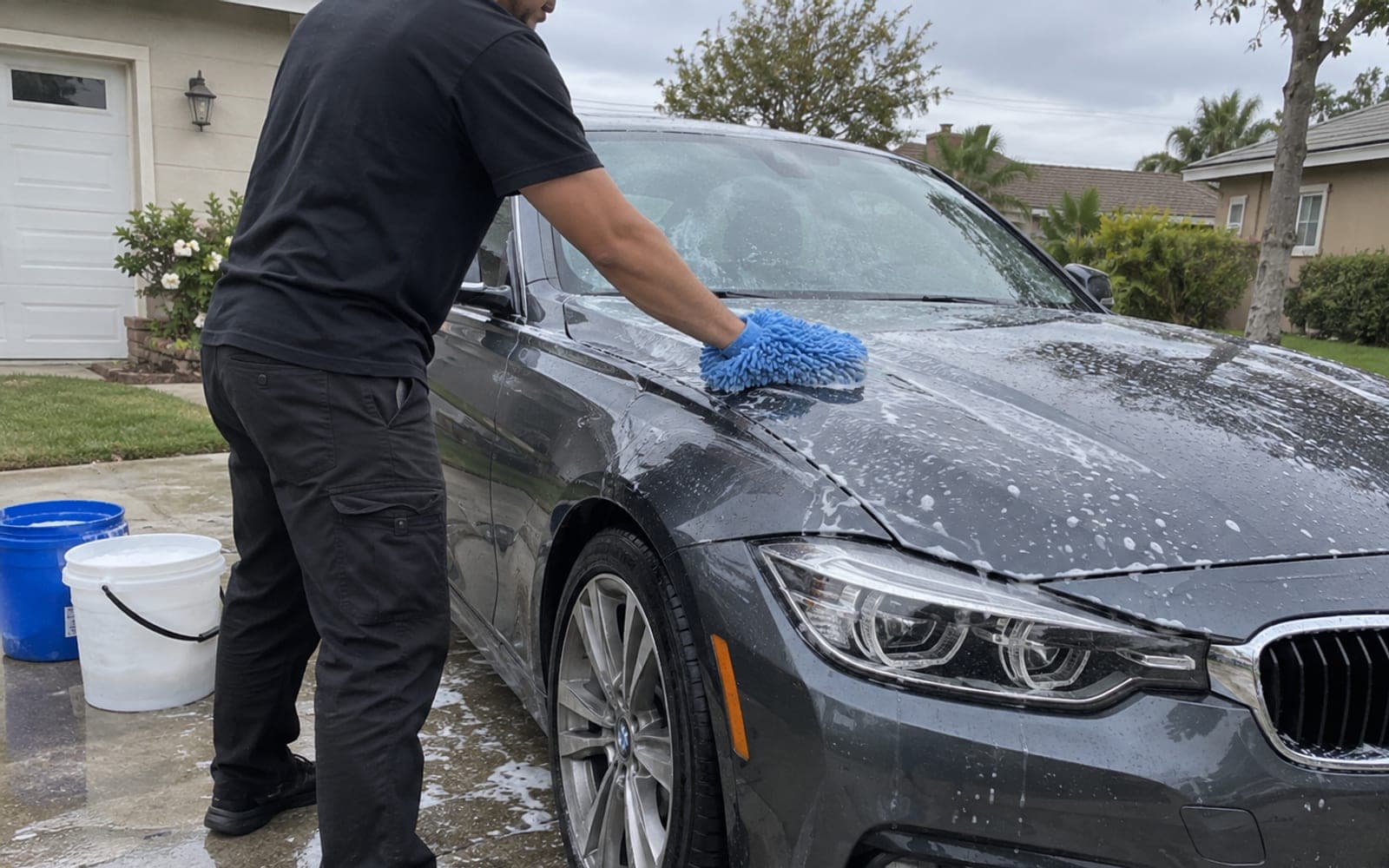
A hand wash, the contamination off the paint, and protection back on it.
Starting at
$169On a coupe. Final pricing depends on your vehicle, its condition and the services you choose. Start a booking for your exact price.
Get exact pricingWhat this is for
Run the back of your hand across the hood after any wash. If it feels like fine sandpaper rather than glass, the wash did its job and the paint is still contaminated — brake dust embedded in the clear coat, tar, insect residue, mineral deposits. None of that rinses off, and until it is gone nothing applied on top of it will last.
An exterior detail is the sequence that removes it and then puts protection back on a clean surface. That second half is what separates it from a wash: it is the reason the next month of rain runs off instead of sitting on the paint.
Protection applied over contamination fails early, unevenly, and invisibly.
What is included
Two-bucket hand wash, wheels and tires cleaned properly, then a sealant so the paint stays slick and easier to keep clean.
The things a detailer would tell you in person.
Said here rather than discovered on the day.
The order
Almost every avoidable scratch on a car was put there by cleaning it in the wrong order. This is the order, and each step exists because of the one before it.
Brake dust is metallic and abrasive. Doing wheels last means carrying that across the paint on the same media, so they are done first with their own tools and their own bucket, and nothing from them touches a panel.
Grit is lifted off and floated away before anything makes contact. A mitt dragged across dry dust is the single most common source of the fine swirling you see on a dark car in the sun.
One bucket carries soap, the other rinses the mitt between panels so the grit ends up in the bottom of a bucket rather than back on the vehicle. Slower on purpose.
Treated separately with products that dissolve them, and given time to work rather than scrubbed. Insect residue is acidic and will etch clear coat if it is left through a summer.
An iron remover dissolves the embedded metal particles chemically, then a clay pass shears off whatever is left mechanically. This is the step a wash does not have, and it is why the paint feels like glass afterward.
Dried with air and soft towels rather than left to spot, then a wax or sealant applied by hand to a surface that is finally clean. Trim, glass and tires are dressed last.
Where the lines fall
These get quoted against each other as if they were the same service at different prices. They are different work, and only two of them are on this page.
Removing what is loose from a vehicle that was detailed recently, and refreshing the protection on it. Fast, because nothing has had time to bond.
Between details
Everything above: wash, chemical and mechanical decontamination, trim, glass and protection on a clean surface. This service.
This page
One machine pass with a polish. Removes the lightest marring, improves gloss and depth, and takes a very small amount of clear coat doing it. Part of the Signature Detail.
Signature Detail
Multiple machine stages under inspection lighting, with paint depth measured as the work goes, to level the clear coat to the bottom of its defects. Quoted in writing after somebody has looked at the paint.
Quoted first
Honestly
The second column is the part most service pages leave out, and it is the part worth reading before you spend anything.
What goes back on
Every protection product does the same fundamental job: put a sacrificial layer between your clear coat and the world. They differ in what they are made of and how long they stay.
Natural, warm-looking, and the least durable. Weeks rather than months, and it softens in summer heat. The right answer for a garaged vehicle and for anyone who enjoys applying it.
A polymer that bonds to the clear coat. Gives up a little warmth for several times the life and far better resistance to detergent and salt. The sensible default for a vehicle that lives outdoors.
A semi-permanent cured layer measured in years. It demands that the paint underneath is right first, because it locks in whatever it is applied over — which is why it is quoted after a look rather than added to a wash.
Make paint scratch-proof. A coating adds hardness against very light marring; it will not stop a shopping cart, a stone chip or a careless wash. Anything sold as scratch-proof is describing paint protection film, which is a different product.
Eligible vehicles
Any painted road vehicle. Tell us at booking if it carries a wrap, a matte or satin finish, aftermarket paint or an existing coating — each of those changes the products and one of them rules out a normal wash entirely.
Request a quote for specialized or oversized vehicles, and we will price it from the measurement rather than from a category.
Add-ons
Nothing reaches your total unless you choose it. Each one is priced and itemized separately in the booking flow, before you confirm.
+ 20 minutes
Sensitive areas covered, degreased, rinsed and dressed.
+ 25 minutes
Sanded, polished and sealed. Priced for the pair.
+ 20 minutes
A ceramic-infused topper over the sealant for longer beading.
+ 35 minutes
The roof washed and a UV treatment applied to the membrane.
+ 25 minutes
The awning extended, washed both sides and dried before it is rolled back.
+ 35 minutes
Canvas cleaned and re-proofed, clears cleaned and polished with a plastic-safe polish.
+ 10 minutes
Chain degreased, cleaned and re-lubricated.
+ 55 minutes
Tanks, stacks, bumper and wheels hand polished.
On the day
Protection applied to a wet panel does not bond, and a wash finished in rain is a wash paid for twice. We contact you to reschedule rather than turning up and pushing through.
Water freezes in door shuts and on glass and nothing cures. Below freezing, exterior work waits.
Not a cancellation. Panels are worked in shade or in sections so nothing dries on the paint, which is how water spots get etched in during a wash.
Read next
A service page says what the work consists of. A vehicle page says what is different about the thing it is being done to, and an article goes into one part of it properly.
A wash removes what is loose. Everything else on your paint is bonded to it. Here is what each contaminant actually is, what it does if left, and the step that removes it.
Three products, three different jobs, and a lot of marketing in between. What each one actually is, what it protects against, and which is worth the money for the way you use your vehicle.
An automatic wash is fast and cheap and it is the right answer more often than detailers like to admit. Here is what it does well, what it costs your paint, and where the line actually falls.
Not quite it?
Each one carries its own checklist, so the comparison is here rather than back on the services page.
A full reset of everything you touch, sit on and breathe.
5 inside · Nothing outsideSee what is includedInside and out in one visit, finished to one standard.
5 inside · 7 outsideSee what is includedA Complete Detail plus paint enhancement and longer protection.
6 inside · 10 outsideSee what is includedBooking the exterior detail on a regular schedule keeps each visit to upkeep rather than recovery. See how recurring care works.
Questions
No, and the difference is the decontamination. A hand wash removes what is loose. This removes what has bonded to the clear coat — embedded iron, tar, insect residue, mineral deposits — and then applies protection to the clean surface. That last part is what makes the result last weeks rather than days.
No. Swirl marks are thousands of shallow scratches in the clear coat rather than contamination on top of it, and leveling them means removing a little clear coat with a machine. That is paint enhancement, which is part of the Signature Detail, or paint correction, which is quoted after somebody has looked at the paint.
It depends far more on how the vehicle is washed and where it is parked than on the product. A sealant on a car washed properly by hand routinely outlasts a coating on a car put through a friction tunnel every week. What reliably shortens it: high-alkaline detergent, brushes, heat, and bird droppings left to sit.
Not as part of this service. It is careful work involving masking, and it is worth doing properly or not at all, so it is handled separately rather than added to a wash.
Usually. We carry our own water and power and need roughly a parking space and a half. Some properties ask for notice before a contractor works on site, which is worth checking with your management first.
Yes, and however is convenient. Getting salt, sap and bird droppings off quickly matters more than the method, and a vehicle with a healthy layer of protection tolerates an imperfect wash far better than a bare one does.
Book in two minutes
Enter your ZIP code to confirm we serve your location and see the windows we have open.
No depositTwo-hour arrival windowsWe come to you