How to prepare for a mobile detail

Five minutes before we arrive buys you time on the vehicle instead of around it.

Detail Gents guidesPublished 4 min read

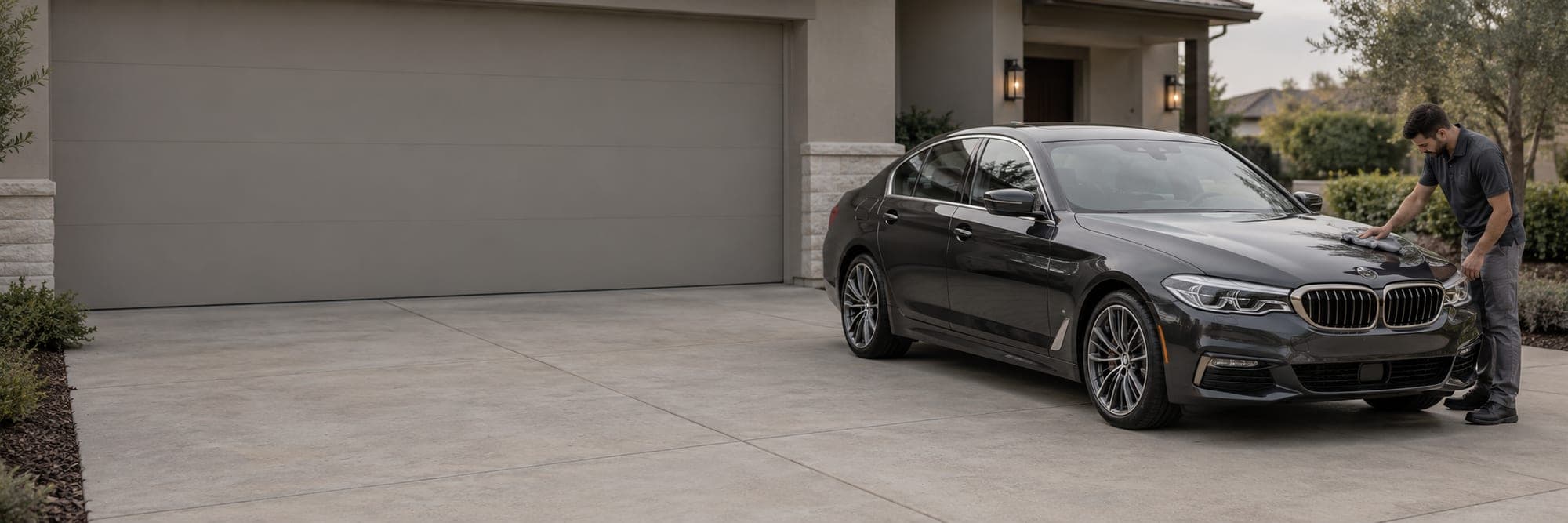
A Detail Gents detailer finishing a dark sedan on a home driveway

A mobile detail needs almost nothing from you, which is the point of it. But a few minutes beforehand genuinely changes how much of the appointment is spent on the vehicle rather than around it — and two of the items below can decide whether the work can happen at all.

Somewhere to work

Roughly a parking space and a half. We need to open every door fully, walk a full circuit of the vehicle, and put the van close enough to run hoses and cables.

A driveway
Ideal. If the driveway is on a slope, tell us — water management on a slope is a different setup.
An apartment or condo lot
Works well. Check whether your property requires notice for a contractor on site, and tell us the building or space number when you book.
An office lot or garage
Common and straightforward. Underground garages sometimes have a height limit that a service van will not clear, and a low ceiling restricts what can be done to a roof.
Street parking
Usually fine on a quiet street. A busy road is a safety problem for the side of the vehicle facing traffic, and we would rather move than work badly.

Clear the interior — five minutes

This is the part that most affects how much of the time goes into cleaning rather than moving things.

  • Take out anything you would not want handled: documents, medication, electronics, chargers, sunglasses
  • Remove anything valuable, including loose cash and anything in the glovebox you care about
  • Take out child seats if you are able to, and want the seat underneath cleaned — we will not remove or reinstall them, because reinstalling one incorrectly is not a risk worth taking
  • Clear the trunk or cargo area if you want it done; a full trunk gets vacuumed around rather than cleaned
  • Take out aftermarket seat covers and any organizer you want the space behind cleaned

What you do not need to do: vacuum anything, wipe anything, or take the car anywhere first. Arriving to a car someone has pre-cleaned is a small waste of your evening.

Two things worth telling us in advance

The real condition
Pet hair, a spill that soaked in, smoke, mold, or a vehicle that has not been cleaned in a long time. Each of those adds genuine time, and knowing at booking means the right block is reserved. Finding out on arrival means either a rushed job or a conversation about re-quoting on your driveway.
Anything unusual about the vehicle
A wrap or vinyl graphics, a matte or satin finish, a soft top, aftermarket paint, an existing ceramic coating, a known leak, or trim that is already loose. All of these change products or method, and a couple of them rule out a normal wash entirely.

None of this is a test. It is how the appointment ends up being the right length. What each factor does to the price is covered in what actually changes the price of a detail.

Weather

Interior work happens in almost any weather. Exterior work does not, and there is no version of this where pushing through is the right call.

Steady rain
Exterior work gets rescheduled. Protection applied to a wet panel does not bond, and a wash finished in rain is a wash you paid for twice.
Freezing temperatures
Water freezes in door shuts and on glass, and products do not cure. Below freezing, exterior work moves.
High wind
Grit blows onto wet panels faster than it can be rinsed off. It is the least obvious of the three and the most likely to cause damage.
Direct summer sun
Not a cancellation, but it changes the approach — panels are worked in shade or in sections so nothing dries on the paint.

On the day

You do not need to be there. Plenty of appointments happen while someone is at work or in a meeting, and we will leave the vehicle locked exactly where we found it with photographs sent through.

If you are there, the useful moments are two: a minute at the start to point out anything you are particularly concerned about, and a minute at the end to walk around the finished vehicle together. Everything in between is better spent doing something else.

  • Leave the keys, or the fob, somewhere we can reach the vehicle
  • Tell us if a gate code, a garage remote or a parking pass is involved
  • Let us know if there is a hard stop — if you need the vehicle at three, we will plan the visit around that rather than discover it

Straight afterward

  • Give freshly conditioned leather and dressed trim a short while before sliding across them
  • If the interior was extracted, leave a window cracked when the weather allows — airflow finishes the drying
  • Avoid an automatic wash for a few days after protection is applied, so it cures undisturbed
  • Look over the vehicle in daylight while we are still there. Anything missed is far easier to put right in the first five minutes than the next day

What this applies to

Keep reading

Related articles

Chosen by what they have in common with this one, rather than by what was published most recently.

Two Detail Gents detailers hand drying a black BMW X7 on a stone driveway beside a branded van
Detail Gents guides

How long does a car detail take?

The honest answer is a range, and the range is not evasion — it is the vehicle, the condition and the service level doing the work. Here is what moves the clock, and how to plan around it.

Book in two minutes

Ready to book it?

Enter your ZIP code, tell us what you drive, and we will show you the arrival windows we have open.

No depositTwo-hour arrival windowsWe come to you